
Publications
You can also find my articles on my Google Scholar profile.
Conference Papers
Adaptive Information Control for Search-Augmented LLM Reasoning
In Findings of the Association for Computational Linguistics: EMNLP 2026
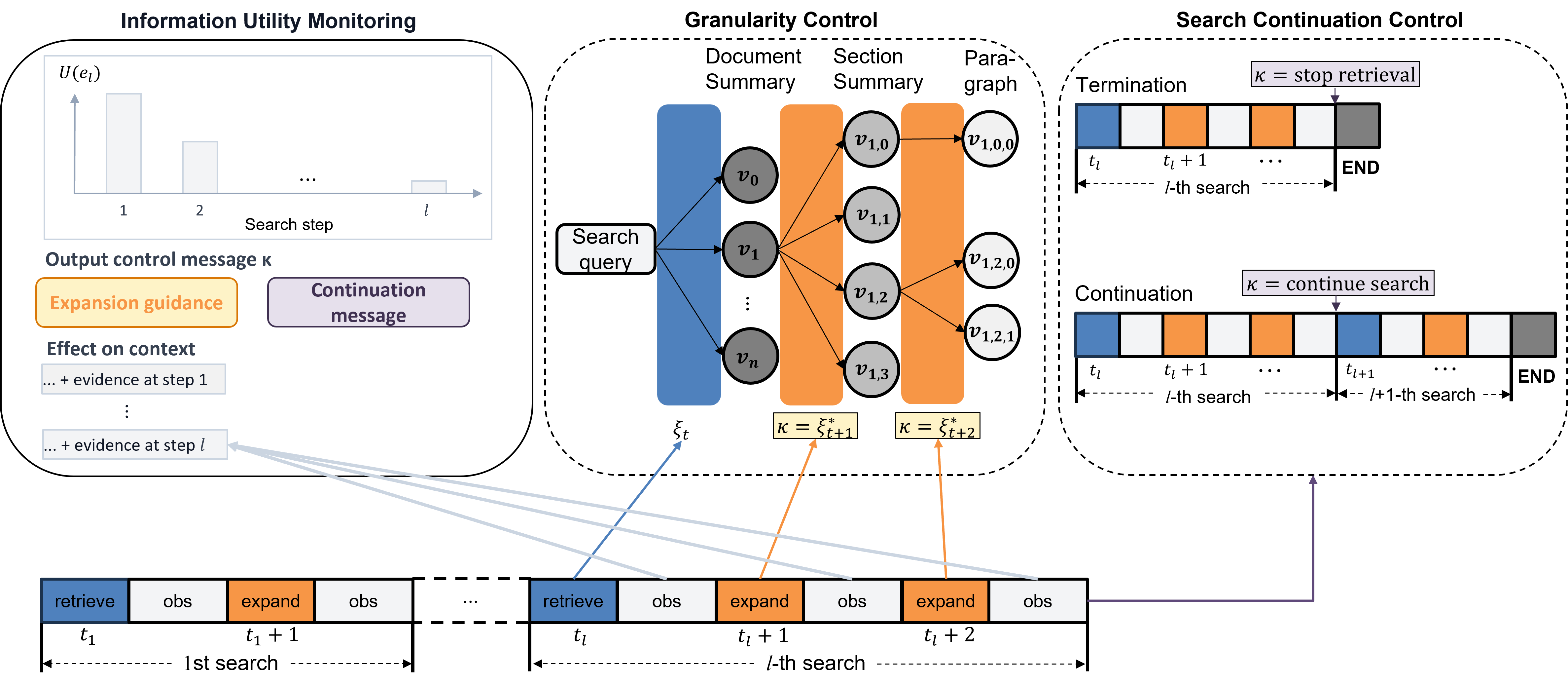
Search-augmented reasoning agents interleave multi-step reasoning with external retrieval, but uncontrolled retrieval can introduce redundant evidence, saturate the context, and destabilize reinforcement learning (RL). Existing outcome-based RL methods provide only sparse terminal rewards, offering limited guidance for intermediate information-acquisition decisions. We propose DeepControl, an adaptive information-control framework based on information utility, a state-dependent estimate of the marginal value of retrieved evidence. The framework regulates information acquisition along two axes: extent, i.e., whether retrieval should continue, and resolution, i.e., how much retrieved detail should be exposed. It implements these controls through retrieval-continuation guidance, hierarchical granularity control, and an annealed control-forcing scheme. This enables the policy to internalize effective acquisition behavior during training and operate without external control at test time. Across seven benchmarks, DeepControl consistently outperforms strong RL and retrieval baselines without explicit information control; compared with Search-R1, it improves average performance by +9.4 and +8.6 points on Qwen2.5-7B and Qwen2.5-3B, respectively. Additional analyses show improved search effectiveness, training stability, and evidence utilization.
PathWise: Planning through World Model for Automated Heuristic Design via Self-Evolving LLMs
In Proceedings of the 43rd International Conference on Machine Learning (ICML 2026)
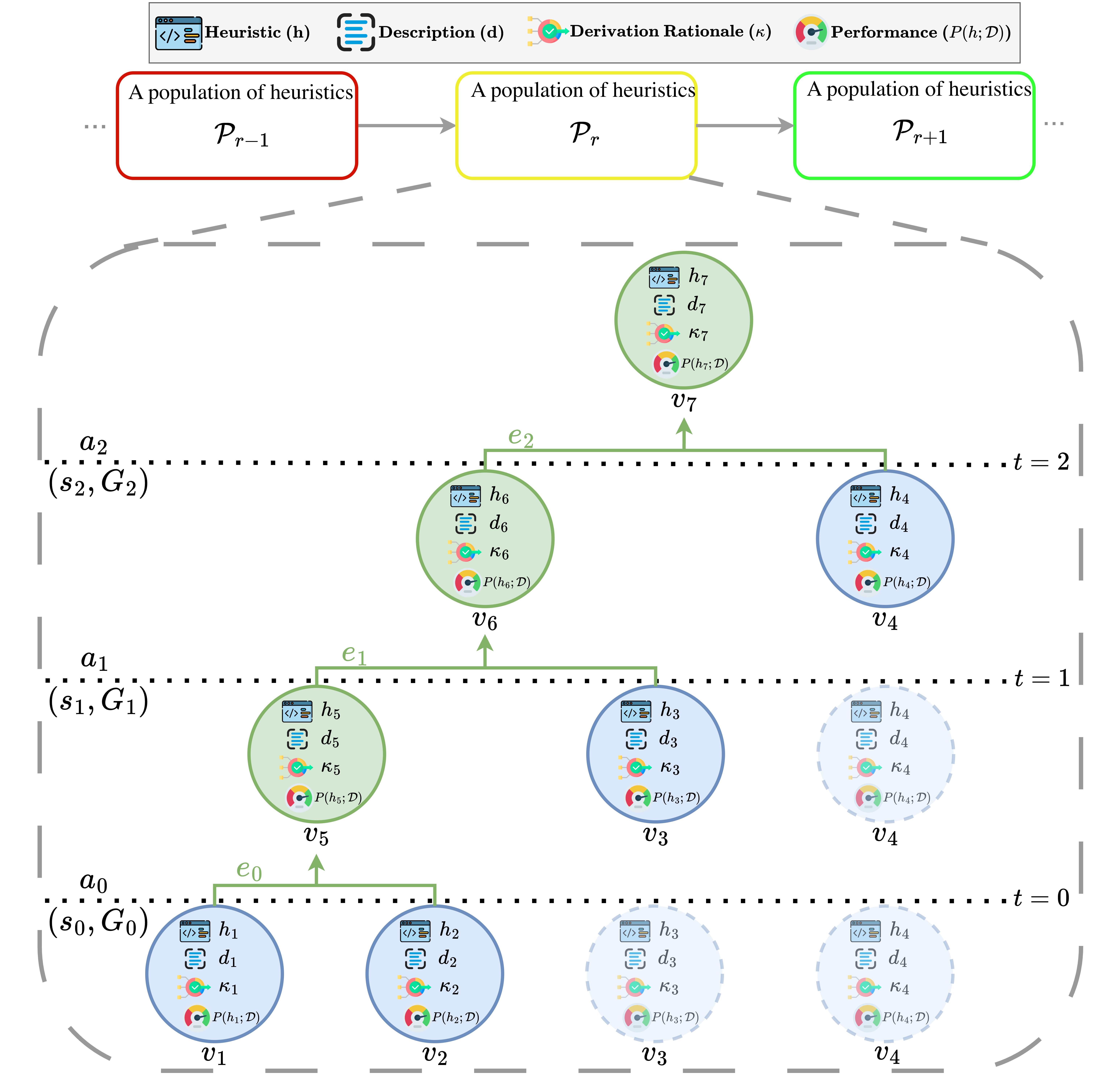
Large Language Models (LLMs) have enabled automated heuristic design (AHD) for combinatorial optimization problems (COPs), but existing frameworks' reliance on fixed evolutionary rules and static prompt templates often leads to myopic heuristic generation, redundant evaluations, and limited reasoning about how new heuristics should be derived. We propose a novel multi-agent reasoning framework, referred to as Planning through World Model for Automated Heuristic Design via Self-Evolving LLMs (PathWise), which formulates heuristic generation as a sequential decision process over an entailment graph serving as a compact, stateful memory of the search trajectory. This approach allows the system to carry forward past decisions and reuse or avoid derivation information across generations. A policy agent plans evolutionary actions, a world model agent generates heuristic rollouts conditioned on those actions, and critic agents provide routed reflections summarizing lessons from prior steps, shifting LLM-based AHD from trial-and-error evolution toward state-aware planning through reasoning. Experiments across diverse COPs show that PathWise converges faster to better heuristics, generalizes across different LLM backbones, and scales to larger problem sizes.
Saliency-Aware End-to-End Learned Variable-Bitrate 360-Degree Image Compression
In IEEE International Conference on Image Processing (ICIP 2024)
abs paper
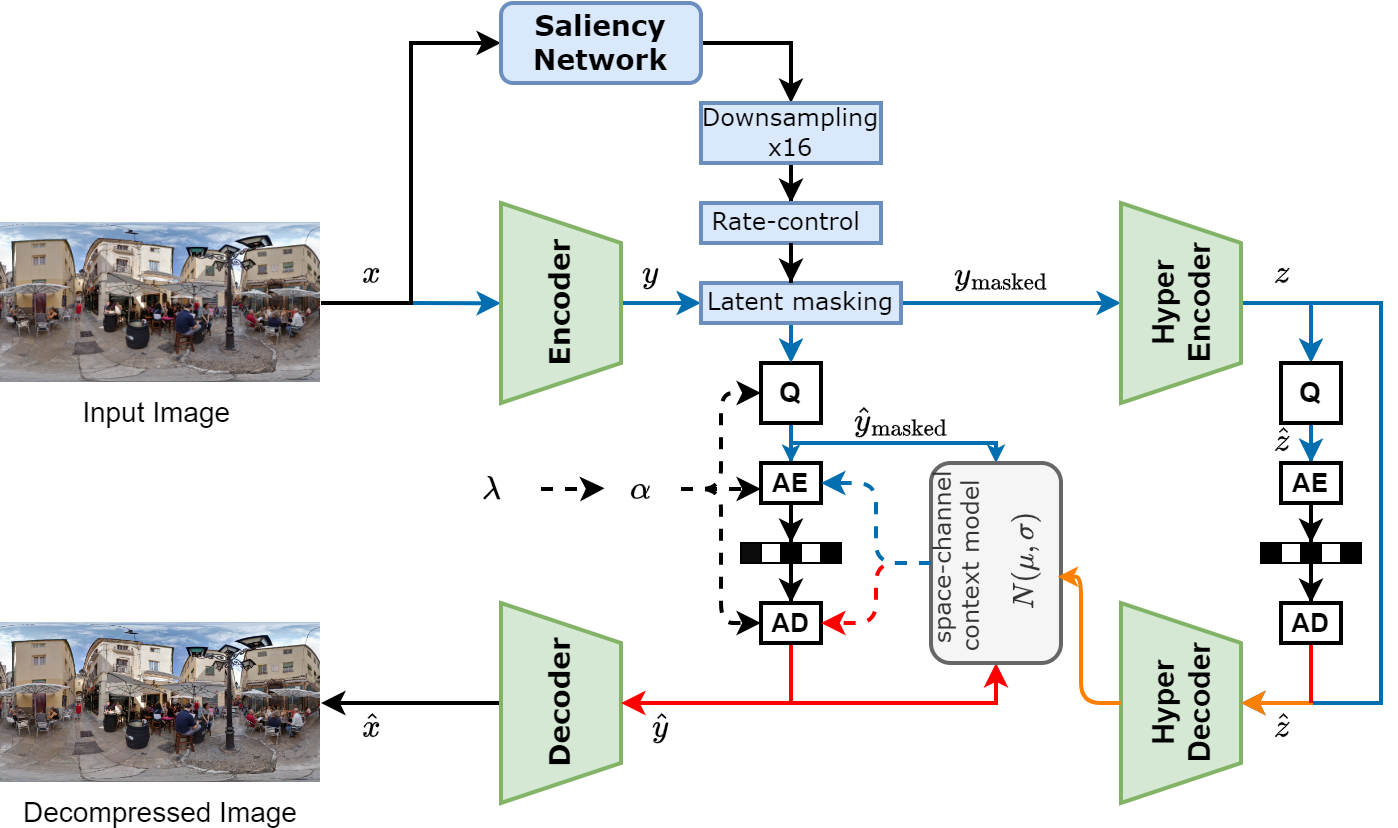
Effective compression of 360° images, also referred to as omnidirectional images (ODIs), is of high interest for various virtual reality (VR) and related applications. 2D image compression methods ignore the equator-biased nature of ODIs and fail to address oversampling near the poles, leading to inefficient compression when applied to ODI. We present a new learned saliency-aware 360° image compression architecture that prioritizes bit allocation to more significant regions, considering the unique properties of ODIs. By assigning fewer bits to less important regions, significant data size reduction can be achieved while maintaining high visual quality in the significant regions. To the best of our knowledge, this is the first study that proposes an end-to-end variable-rate model to compress 360° images leveraging saliency information. The results show significant bit-rate savings over the state-of-the-art learned and traditional ODI compression methods at similar perceptual visual quality.
Workshop Papers
Scaling Search-Augmented LLM Reasoning via Adaptive Information Control
In Workshop on Scaling Post-training for LLMs (SPOT), ICLR 2026
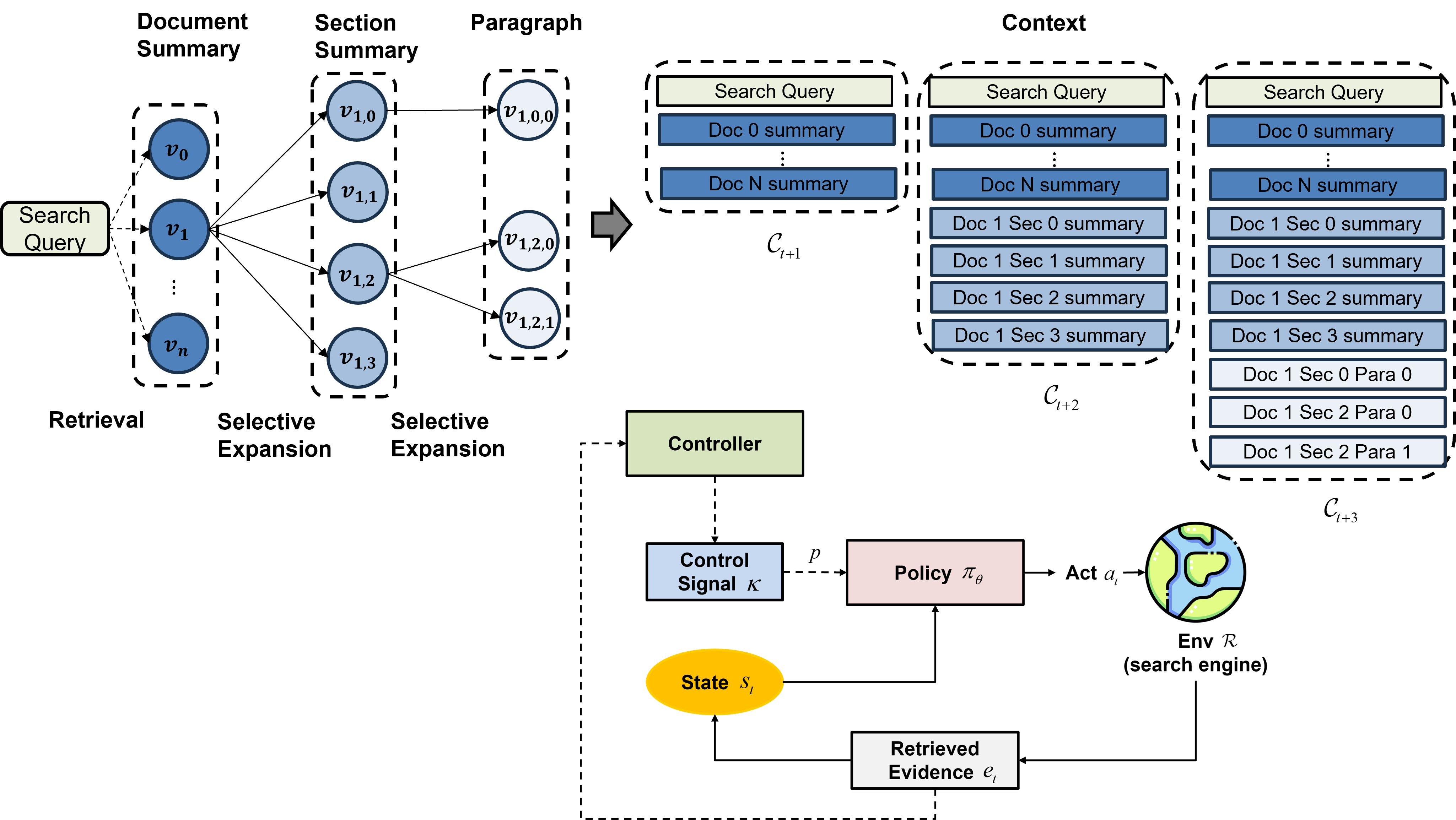
Search-augmented reasoning agents interleave multi-step reasoning with external information retrieval, but uncontrolled retrieval often leads to redundant evidence, context saturation, and unstable learning. Existing approaches rely on outcome-based reinforcement learning (RL), which provides limited guidance for regulating information acquisition. We propose DeepControl, a framework for adaptive information control based on a formal notion of information utility, which measures the marginal value of retrieved evidence under a given reasoning state. Building on this utility, we introduce retrieval continuation and granularity control mechanisms that selectively regulate when to continue and stop retrieval, and how much information to expand. An annealed control strategy enables the agent to internalize effective information acquisition behaviors during training. Extensive experiments across seven benchmarks demonstrate that our method consistently outperforms strong baselines. In particular, our approach achieves average performance improvements of 9.4% and 8.6% on Qwen2.5-7B and Qwen2.5-3B, respectively, over strong outcome-based RL baselines, and consistently outperforms both retrieval-free and retrieval-based reasoning methods without explicit information control. These results highlight the importance of adaptive information control for scaling search-augmented reasoning agents to complex, real-world information environments.
Preprints
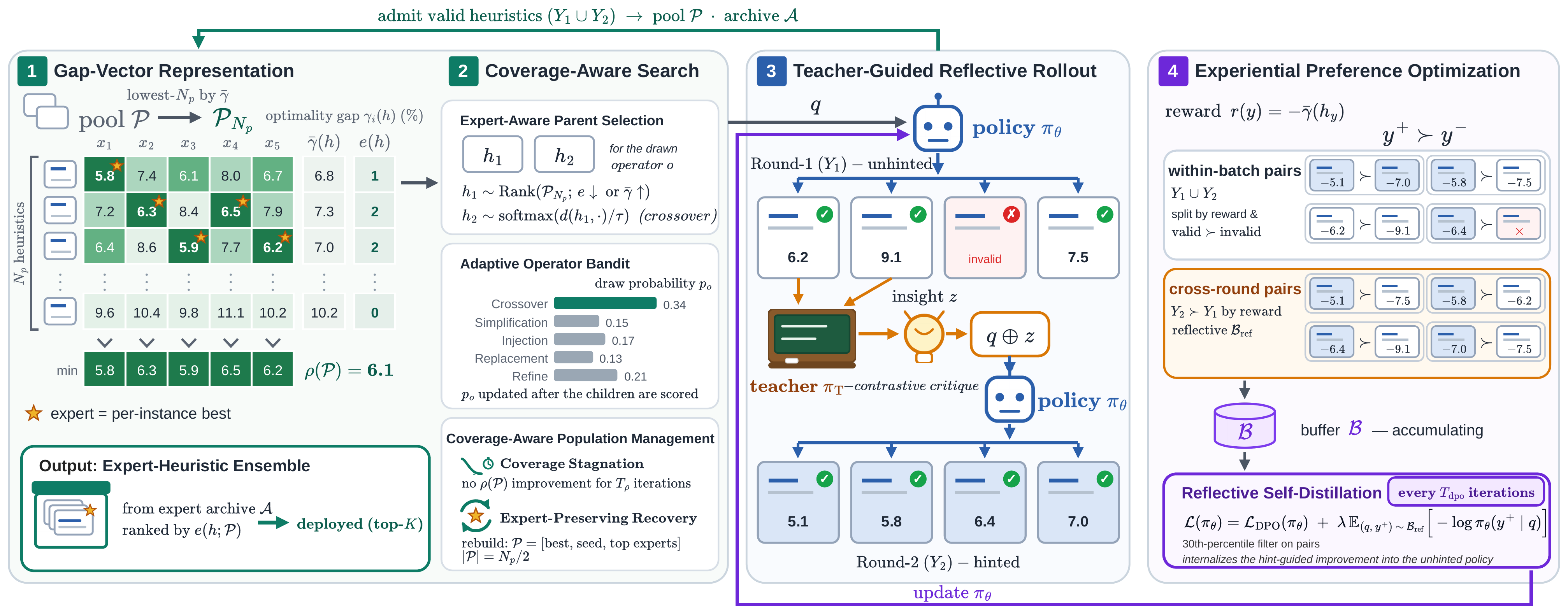
EPOCH: Coverage-Aware Evolution with Experiential Preference Optimization for LLM-based Automated Heuristic Design
abs paper
LLM-based automated heuristic design (AHD) discovers executable heuristics for NP-hard combinatorial optimization problems (COPs), where a large language model (LLM) generates candidate heuristics inside an evolutionary search. In existing frameworks, the generator either stays frozen or is fine-tuned on a scalar fitness signal that cannot show which instances each heuristic covers. Reflection-based frameworks improve heuristics with natural-language feedback, but the feedback stays in the prompt and the generator itself does not learn from it. We propose EPOCH, which sets instance coverage as the objective of the evolutionary search and fine-tunes the generator to internalize reflection. Parent selection, operator allocation, and stagnation recovery all optimize how well the heuristics jointly cover the training instances, so the search returns a complementary ensemble of heuristics. The generator learns from its own search through experiential preference optimization. A teacher LLM returns a natural-language insight on the generated heuristics, and the generator produces new heuristics with this insight. The resulting improvements join the preference pairs used for direct preference optimization (DPO). Because DPO only teaches the generator to rank these improvements, a reflective self-distillation (RSD) term makes it more likely to generate them on its own, and the gains accumulate over the long horizon of the evolutionary search. In experiments across COPs and open-source LLM backbones, the heuristic ensembles discovered by EPOCH outperform inference-only and fine-tuned LLM-based AHD baselines and generalize across problem scales.
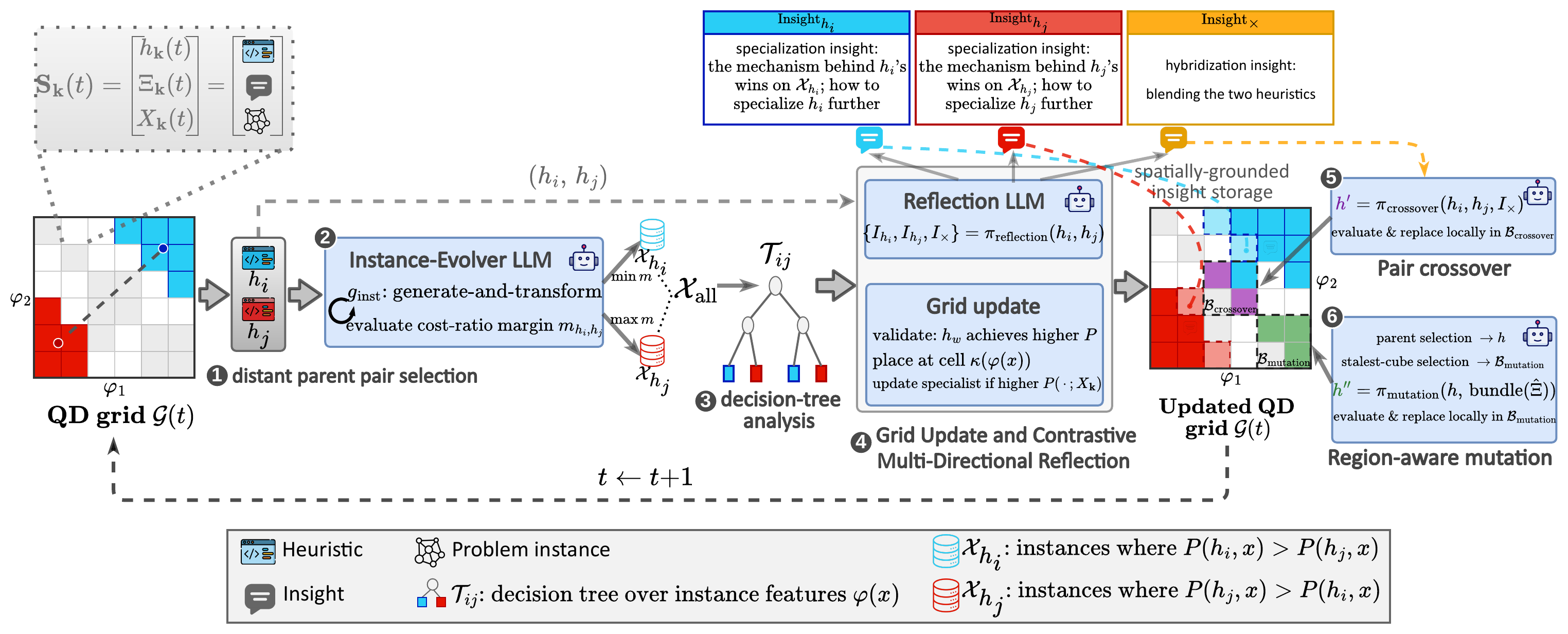
MOSAIC: Adversarial Co-evolution of Specialist Heuristics and Problem Instances for LLM-based Automated Heuristic Design
abs paper
Automated heuristic design (AHD) with large language models (LLMs) has produced strong heuristics for combinatorial optimization problems (COPs). Yet existing frameworks optimize for average performance on a small fixed dataset and steer the search with "verbal gradients" distilled from scalar better/worse feedback. No single heuristic dominates across instance distributions, and scalar feedback tells the LLM whether a heuristic improved, but not where in the instance space or why. We propose MOSAIC, a grid-based framework that adversarially co-evolves problem instances and specialist heuristics inside a Quality-Diversity (QD) archive indexed by structural instance features. Instances evolve to expose weaknesses of the current heuristics, and heuristics evolve to eliminate them by specializing to the newly exposed regions. Each archive cell keeps a specialist heuristic, representative instances, and insights explaining what works in its region, forming a persistent memory that accumulates over the evolutionary search. For each heuristic pair sampled from distant grid regions, an LLM-guided evolutionary loop generates discriminative instances, and a decision tree identifies the feature-space regions where each heuristic wins. A reflection LLM then contrasts the two heuristics to produce multi-directional insights that persist in those regions and guide crossover and mutation. The archive is simultaneously a co-evolved benchmark of discriminative instances and a pool of region specialist heuristics, from which greedy selection extracts a compact complementary portfolio. Across COPs, test sizes, and LLM backbones, the portfolio consistently outperforms state-of-the-art LLM-based AHD methods, and the co-evolved instances attain higher feature-space coverage and stronger heuristic discrimination than evolutionary instance-generation baselines.
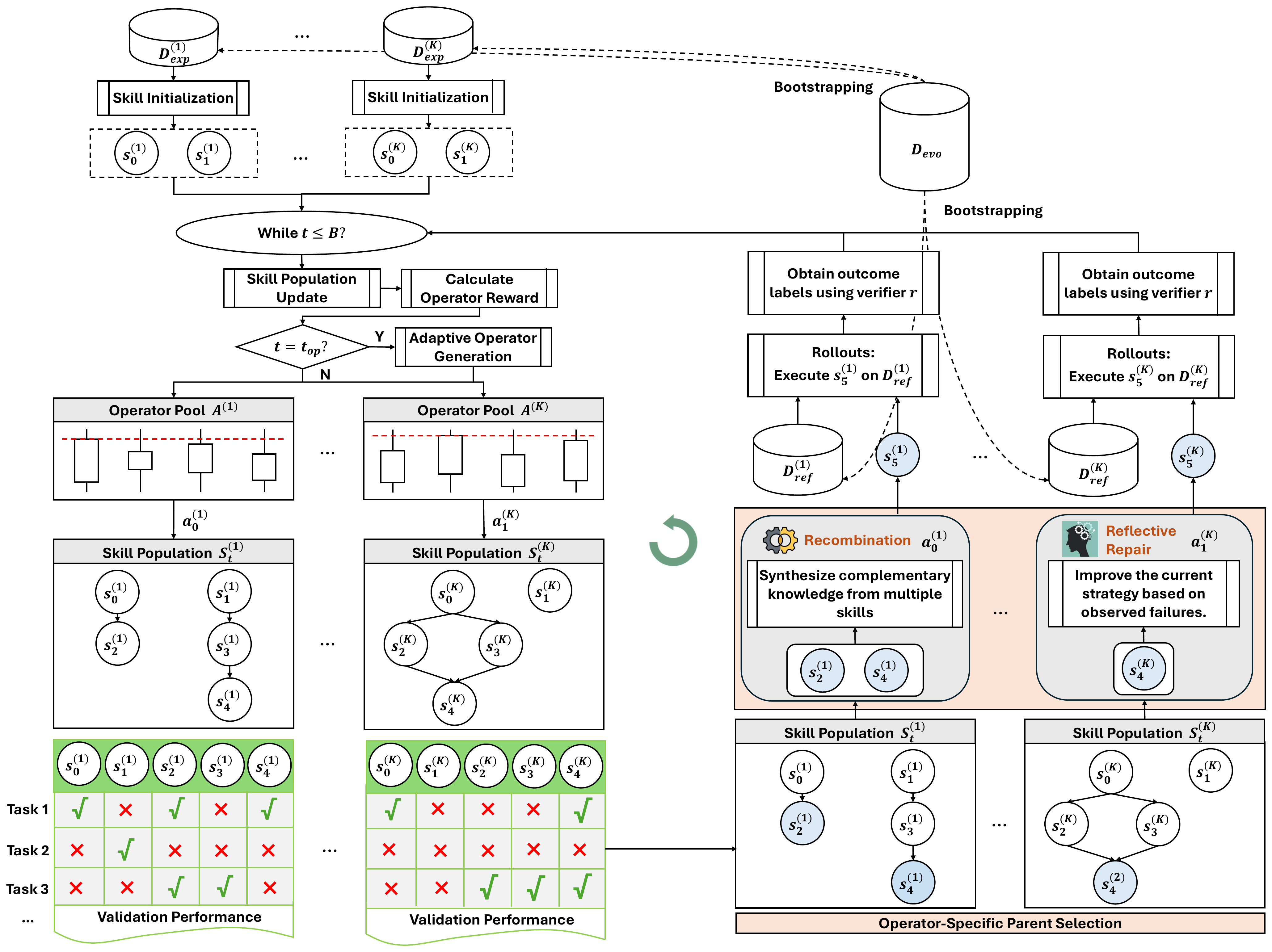
DIVE: Unlocking Self-Improvement in Frozen Language Models Through Diversity-Driven Skill Evolution
abs paper
Large language models (LLMs) cannot retain post-deployment experience without parameter updates. We introduce DIVE, a diversity-driven framework that enables frozen LLMs to improve by evolving persistent natural-language skills from task experience and verifier feedback. These skills encode reusable reasoning procedures, verification strategies, common failure modes, and output constraints and are both executed and revised by the same underlying model without access to a teacher model. Since natural-language skill evolution is a stochastic, non-convex search process, optimizing a single skill trajectory can overfit to sampled experience or converge to a suboptimal solution. DIVE mitigates this optimization variance by independently evolving multiple skill populations from bootstrapped experience, adaptively refining them through diverse transformations, and jointly selecting a complementary set of skills. Across six mathematical and logical reasoning tasks and multiple model families, DIVE consistently outperforms existing reasoning methods, prompt-optimization approaches, skill-development frameworks, and memory-based baselines. It achieves rapid self-improvement from accumulated experience, obtaining substantially larger performance gains with fewer rollouts than parameter-based methods such as SFT and GRPO, and prompt optimization with GEPA. Further, the resulting skills transfer across model scales and families, enabling smaller models such as GPT-5-nano to match or outperform larger counterparts, i.e., GPT-5, under conventional prompting. These results establish diversity-driven skill evolution as an effective, interpretable, and parameter-free approach to LLM self-improvement.
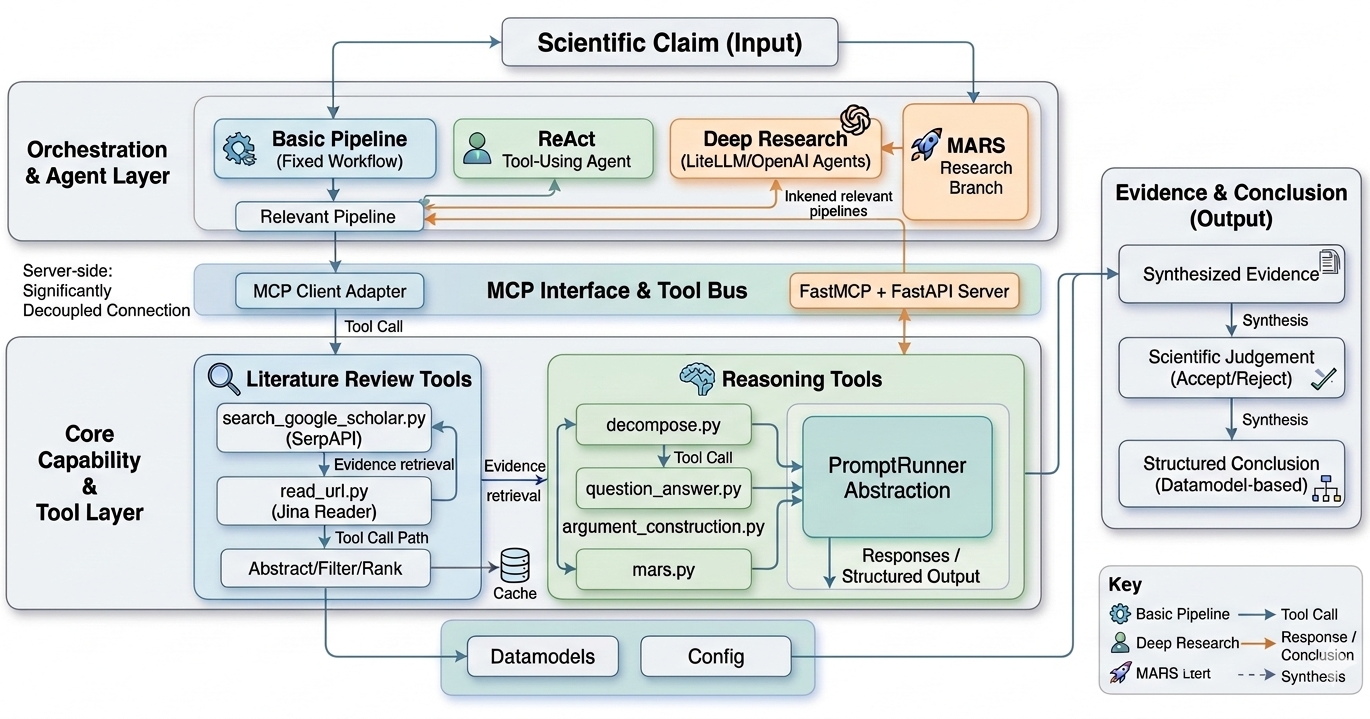
DeepVerify: Evidence-Based Expert-Level Scientific Claim Verification